Build vs. Buy AI Infrastructure: Strategic Decisions for Product and Engineering Leaders
Explore the strategic build vs. buy dilemma for AI infrastructure. Essential insights for product and engineering leaders on customization, speed, cost, and control.

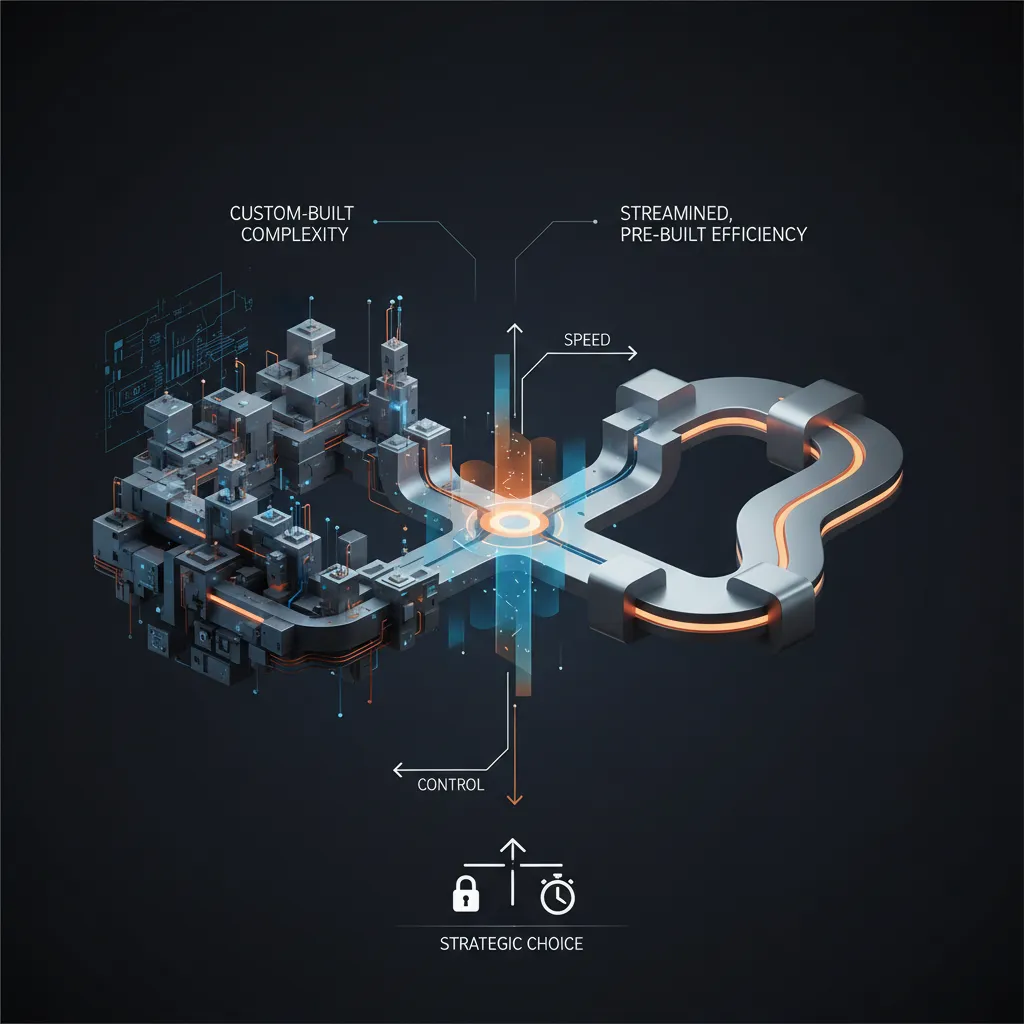
The rapid evolution of artificial intelligence has thrust a critical decision upon product and engineering leaders: whether to build AI infrastructure in-house or leverage existing third-party solutions. This choice carries significant implications for resource allocation, time-to-market, differentiation, and long-term strategic flexibility.
This article explores the fundamental considerations for making an informed build vs. buy decision for AI infrastructure, moving beyond simple cost analysis to deeper strategic implications.
Understanding the Core Dilemma
AI infrastructure encompasses everything from data pipelines and model training platforms to inference engines, MLOps tools, and monitoring systems. The "build vs. buy" question here isn't just about a single component, but often a stack of integrated tools and services. The right decision hinges on a clear understanding of your organizational capabilities, strategic objectives, and the specific problem you're trying to solve with AI.
Arguments for Building AI Infrastructure
1. Deep Customization and Differentiation
Building allows for tailor-made solutions that precisely fit unique business logic, proprietary algorithms, or highly specific performance requirements. This can be crucial for AI applications that form the core competitive advantage of your product.
2. Full Control Over the Stack
Ownership of the entire stack provides complete control over security, privacy, performance, and future extensibility. It mitigates vendor lock-in risks and allows for internal expertise development.
3. Cost Efficiency at Scale (Long Term)
While initial investment is high, building can become more cost-effective than recurring subscription fees for large-scale, high-volume AI workloads, especially when vendor pricing models are less favorable for your specific usage patterns.
4. IP Ownership and Competitive Advantage
Developing unique AI infrastructure can lead to valuable intellectual property, strengthening your market position and creating barriers to entry for competitors.
Arguments for Buying AI Infrastructure
1. Speed and Time-to-Market
Leveraging existing solutions drastically reduces development time and effort. Teams can focus immediately on model development and application logic rather than plumbing.
2. Access to Specialized Expertise and Features
Third-party vendors often offer highly specialized, mature, and battle-tested solutions with features that would be prohibitively complex or expensive to replicate internally. This includes advanced MLOps features, GPU orchestration, or specialized data processing.
3. Reduced Operational Burden
Managed services offload the operational overhead of maintenance, scaling, security patching, and infrastructure upgrades to the vendor, freeing up internal engineering resources.
4. Predictable Costs (Short Term)
Subscription-based models offer more predictable costs in the short to medium term, making budgeting simpler, especially for early-stage or rapidly evolving projects.
Key Factors Influencing the Decision
- Core Competency: Is AI infrastructure development part of your company's core business or a means to an end? If your product is an AI platform, building makes more sense. If AI is an enabling feature, buying might be better.
- Differentiation: Does building unique infrastructure provide a significant competitive advantage that cannot be achieved with off-the-shelf tools?
- Resources & Expertise: Do you have the engineering talent, time, and financial resources to build, maintain, and evolve complex AI systems?
- Scale & Performance: What are your current and projected scaling needs? How critical are performance and latency? Some specialized workloads might necessitate building.
- Security & Compliance: Are there specific regulatory or security requirements that third-party solutions cannot meet, or where greater control is paramount?
- Vendor Lock-in Risk: Evaluate the ease of migration if you need to switch vendors later. Proprietary APIs or data formats can create significant lock-in.
- Total Cost of Ownership (TCO): Beyond initial costs, consider ongoing maintenance, operational staff, patching, upgrades for building, versus subscription fees for buying.
Hybrid Approaches
The build vs. buy decision isn't always binary. Many organizations adopt a hybrid strategy, leveraging commercial solutions for commodity tasks (e.g., cloud compute, basic data storage, generic MLOps tools) while building custom components for their proprietary models, unique data preprocessing, or critical inference serving layers.
For example, using AWS Sagemaker or Google AI Platform for model training and deployment, but building a custom real-time feature store or a specialized inference optimization layer in-house.
Implementing Your Decision
- Start Small: Pilot AI projects often benefit from bought solutions for rapid iteration. As needs mature and scale, evaluate building specific components.
- Define Clear KPIs: Establish metrics for success beyond just technical performance, including ROI, team productivity, and time-to-market.
- Cross-Functional Collaboration: Ensure product, engineering, data science, and security teams are aligned on the strategic choice and its implications.
- Future-Proofing: Consider how your chosen path will accommodate future technological shifts and business growth.
FAQ
What is the biggest risk of building AI infrastructure?
The biggest risk is underestimating the complexity and ongoing operational burden. Building robust, scalable, and secure AI infrastructure requires significant, specialized engineering talent, time, and continuous maintenance, potentially diverting resources from core product development and slowing time-to-market.
When should a startup consider building AI infrastructure?
A startup should consider building AI infrastructure primarily when it forms their core product offering, provides a unique competitive advantage not achievable with existing tools, or when they have highly specialized, proprietary requirements that off-the-shelf solutions cannot meet. Otherwise, leveraging managed services is typically faster and more capital-efficient in early stages.
Can I switch from "buy" to "build" later?
Yes, it is possible, but it can be a complex and costly migration. Starting with bought solutions provides agility, and as your AI needs mature and scale, you can strategically decide to build specific components where differentiation or cost efficiency becomes critical. This often involves a gradual transition rather than an abrupt switch.
How do I evaluate third-party AI infrastructure vendors?
Evaluate vendors based on their features, scalability, reliability, security certifications, pricing models, documentation quality, ecosystem integration, and vendor support. It's crucial to conduct thorough proof-of-concept tests and assess their roadmap alignment with your long-term strategy. Also, consider their reputation and financial stability.