Build vs. Buy AI for Your Product: A Strategic Framework
Navigate the build vs. buy AI decision for your product with our strategic framework. Essential insights for founders, CTOs, and product leaders on custom vs. off-the-shelf AI.

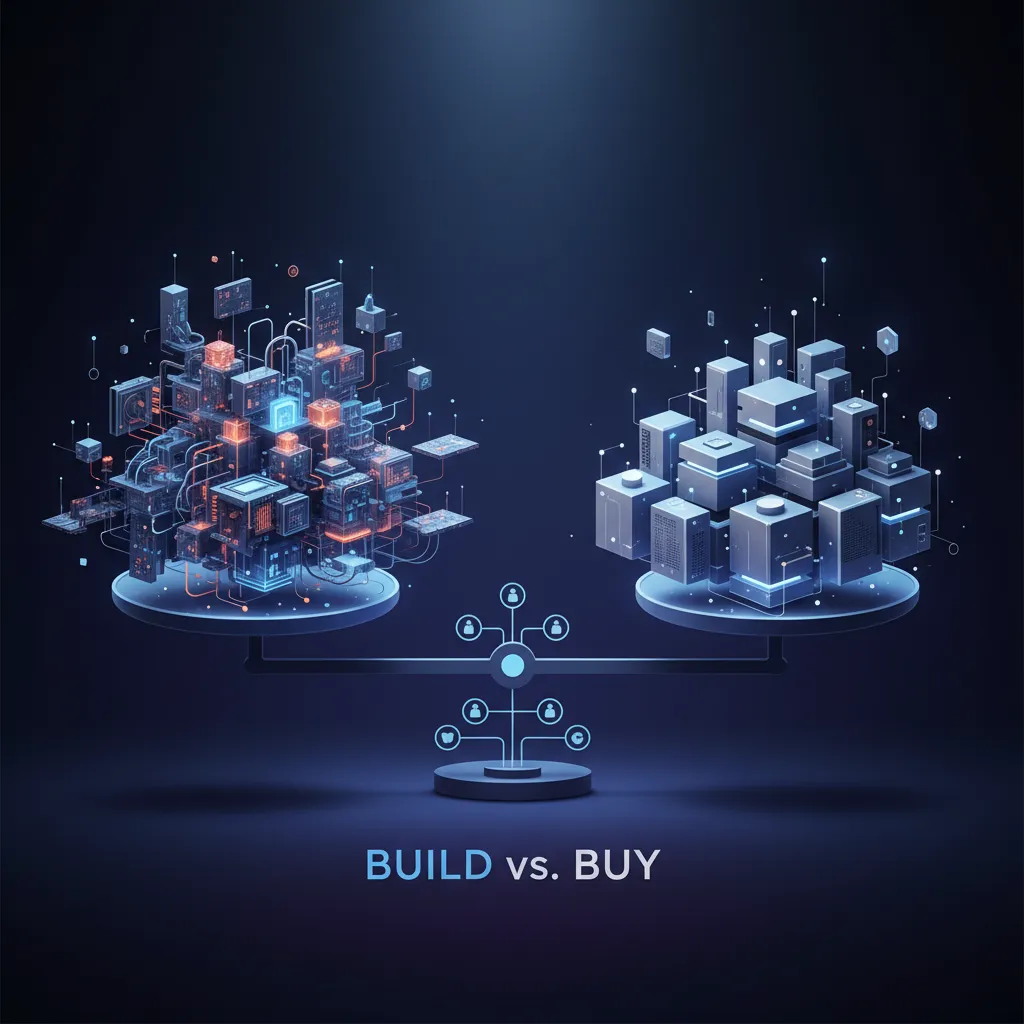
The Strategic Crossroads: Build vs. Buy for AI Product Capabilities
For product leaders and CTOs, the decision to build artificial intelligence capabilities in-house or integrate existing solutions is one of the most critical strategic choices facing modern software development. It's not merely a technical question but one that profoundly impacts differentiation, resource allocation, time-to-market, and long-term product viability. This framework aims to provide a structured approach to navigate this complex decision.
Deconstructing the AI Landscape for Product Development
Before diving into the "build" or "buy" debate, it's crucial to understand the components that constitute AI within a product context:
- Data Infrastructure: The systems for collecting, storing, processing, and managing data, often unique to a product's domain.
- Machine Learning Models: The algorithms themselves, which can range from off-the-shelf pre-trained models (e.g., for language processing) to highly specialized custom models trained on proprietary data.
- ML Operations (MLOps): The engineering discipline focused on deploying, monitoring, maintaining, and scaling machine learning models in production.
- User Experience & Integration: How AI capabilities are exposed to users and integrated seamlessly into the existing product workflow.
Each of these layers presents its own build vs. buy considerations.
The "Build" Imperative: When Custom AI Makes Sense
Choosing to build AI capabilities internally means investing significant resources, but it offers distinct advantages:
- Proprietary Differentiation & IP: If the AI is central to your unique value proposition or creates a competitive moat, building allows for maximum customization and ownership of the intellectual property.
- Deep Integration & Performance: Custom solutions can be architected to fit seamlessly within your existing tech stack, optimizing performance and reducing integration overhead. This is crucial where latency or specific data handling requirements are paramount.
- Cost Optimization at Scale: While initial investment is higher, for very large-scale or highly specialized use cases, a custom-built solution might offer better long-term cost efficiency compared to recurring third-party API costs.
- Full Control & Flexibility: You dictate the roadmap, feature set, underlying algorithms, and data privacy controls without vendor lock-in or limitations.
Example: A fintech company building a fraud detection system based on its unique transaction patterns and regulatory requirements would likely choose to build, as this is a core differentiator and highly specific to their data.
The "Buy" Advantage: Leveraging Existing AI Solutions
Opting for off-the-shelf or API-driven AI solutions can accelerate development and reduce immediate burdens:
- Speed to Market: Integrating a proven third-party service is often significantly faster than developing from scratch, allowing for rapid feature deployment and iteration.
- Reduced Upfront Investment: Avoids the need for specialized AI/ML engineering teams, GPU infrastructure, and extensive research and development. Costs are typically operational (API calls, subscriptions).
- Access to Specialized Expertise: Leverage best-in-class models and infrastructure developed by companies whose core business is AI, often benefiting from their vast datasets and continuous improvements.
- Lower Maintenance Burden: The vendor is responsible for model updates, infrastructure management, security, and scaling, freeing up your internal teams to focus on core product features.
Example: A social media platform wanting to add sentiment analysis to user comments might buy an API service from a major cloud provider, as this is a common task and not necessarily a core differentiator for them.
A Strategic Framework for Decision-Making
1. Define the Problem and Value Proposition
Clearly articulate the problem you're trying to solve with AI. What specific pain point does it address for your users? How does it contribute to your product's overall value? The clearer the problem, the easier it is to assess whether an AI solution is even necessary, and then whether to build or buy it.
2. Assess Core Competency and Strategic Differentiator
- Is the AI capability a fundamental differentiator for your product? If it's what makes your product uniquely valuable, building offers greater control over that competitive edge.
- Is it a commodity feature? If many products offer it and it's not central to your unique selling proposition, buying might be more efficient.
- What are your internal strengths? Do you have unique data, domain expertise, or engineering talent that can create a superior AI solution?
3. Evaluate Data Availability and Uniqueness
The quality and uniqueness of your data are paramount. If you possess proprietary, vast, or highly specialized datasets that are crucial for training a superior model, building might unlock unique capabilities. If the AI relies on general knowledge or public data, off-the-shelf solutions may be sufficient and more cost-effective.
4. Analyze Engineering Resources and Expertise
Building AI requires a specific skill set: data scientists, ML engineers, MLOps specialists. Assess your current team's capabilities and bandwidth. The cost and time to acquire or train these resources can be substantial. Buying mitigates this immediate resource constraint.
5. Consider Time to Market and Urgency
How quickly do you need this AI capability? If speed is critical for capturing market share or responding to competitive pressure, buying a ready-made solution is often the faster path. Building is a long-term investment that requires patience.
6. Total Cost of Ownership (TCO)
Beyond initial investment, consider long-term costs. Building includes R&D, infrastructure, maintenance, scaling, and ongoing model retraining. Buying involves recurring subscription or API fees, but often offloads the operational burden. Perform a thorough financial model for both scenarios over a 3-5 year period.
7. Risk Assessment and Vendor Lock-in
Building carries technical and execution risk. Buying introduces vendor lock-in and potential limitations (e.g., data privacy, feature roadmap, pricing changes). Evaluate the risks associated with each path and have mitigation strategies.
Hybrid Approaches and Iterative Strategy
The build vs. buy decision is rarely binary. Many organizations adopt a hybrid strategy:
- Start with "Buy," Plan to "Build": Use an off-the-shelf solution to validate an idea quickly, then incrementally build custom components as strategic needs evolve and expertise grows.
- Buy Core, Build Edge: Leverage third-party APIs for foundational AI tasks (e.g., basic natural language processing, image recognition) while building custom models on top for highly specialized, differentiating features using your proprietary data.
- Open Source as a Middle Ground: Utilizing open-source ML frameworks and models can offer more control than commercial APIs while reducing some of the R&D burden of building from scratch. This still requires significant internal expertise for deployment and maintenance.
The key is to view this as an evolving strategy. As your product matures, your understanding deepens, and your market shifts, revisit your build vs. buy decisions periodically.
FAQ
When is building AI almost always the superior choice for a product?
Building is superior when the AI is the core product, differentiator, or competitive advantage; when you possess unique, proprietary data essential for superior model performance; or when extreme customization, specific performance requirements (e.g., low latency, on-device processing), or stringent data privacy controls are non-negotiable.
When is buying AI typically the more pragmatic choice?
Buying is more pragmatic when speed to market is paramount, the AI capability is a commodity feature (not a core differentiator), internal ML expertise is limited, or when the cost and effort of building and maintaining a custom solution significantly outweigh the recurring costs of a third-party service for the value derived.
How does a company's data strategy impact the build vs. buy decision for AI?
A robust data strategy is foundational. If you have unique, high-quality, and well-governed proprietary data that provides a distinct advantage, building allows you to fully leverage that asset. If your data is generic or limited, buying pre-trained models or solutions that learn from vast external datasets might be more effective. The ability to collect, process, and use your data ethically and effectively directly influences the viability and benefit of building custom AI.
What are some common "hidden costs" of building AI in-house?
Hidden costs include the ongoing need for specialized talent (retention and recruitment), significant computational infrastructure (GPUs, cloud costs for training/inference), MLOps overhead (monitoring, retraining, versioning), data annotation and cleaning efforts, and the time/effort spent on research and experimentation that may not yield immediate results. These often far exceed initial development costs.
Can a product start with a "buy" approach and later transition to "build"?
Absolutely, this is a common and often recommended strategy. Starting with "buy" allows for quick validation of a feature or concept, gathering real-world user feedback, and understanding the true technical requirements without massive upfront investment. As the feature proves its value and specific needs emerge that off-the-shelf solutions can't meet, a phased transition to "build" or a hybrid approach becomes a strategic evolution, informed by actual product usage and business goals.